A live experiment in North Goa, with an AI digital twin behind it, and what the same idea has done for the governments that tried it before.
For Shri Subhash Phal Dessai, Minister for Social Welfare, Drinking Water, Empowerment of Persons with Disabilities and River Navigation · 3 November 2026 · goa.cyberneticsutra.com
1 / 7What is this thing?
A ₹5 lakh kitty for the shops of North Goa. They decide together what to buy with it.
Think of a village well. No one shop can afford to dig one, every shop drinks from it. A shared delivery scooter, a trainer who visits each shop, one licence that covers ten of them. The shops vote, the kitty pays the person who digs.
For youIt is already running, with private money. Nobody is asking a department to build anything.
2 / 7How it works
Shops say what they need. The AI writes it up. Shops vote. The kitty pays.
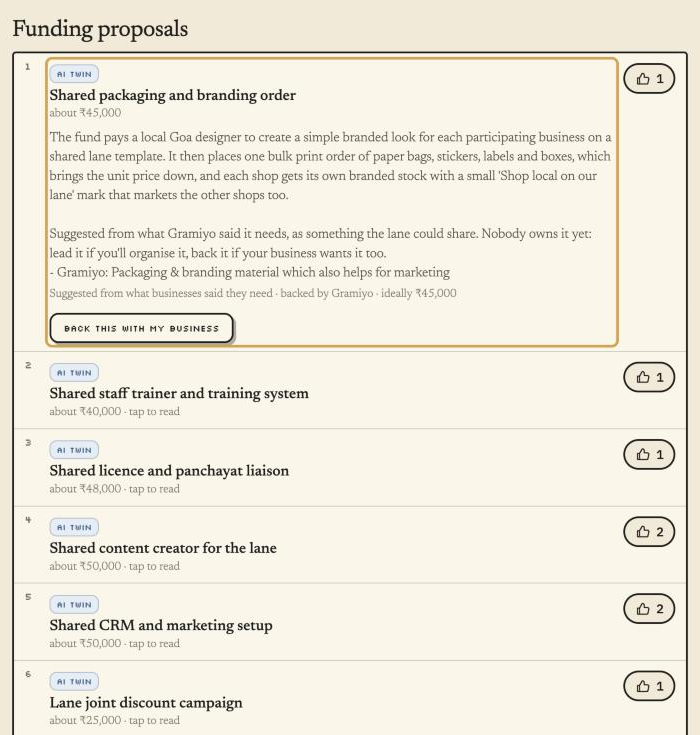
This is the board this morning. A shop signs up on its phone and says what it needs. When two shops need the same kind of thing, the AI writes it up as one proposal, puts a Goa price on it, and notes which government scheme could pay part of it.
The thumb is how many shops want it. Nothing gets a vote until one shop says "I'll run this" and another says "count me in". The kitty pays the printer or the trainer directly. No cash goes to a shop.
For youNo file, no clerk, no counter. A small sum, fixed dates, and anyone in the taluka can open the page and see where the money went.
3 / 7Who did this before
Other places let people vote on the money. Here is what happened.
people voted on a public budgetgovernment runs a digital twin
For youEvery one of these has a politician's name on it, and people still say the name. None of them started bigger than a taluka.
🇧🇷Porto Alegre, 1989: the neighbourhoods queued up the city's building works themselves. Nine years later nearly every house had piped water and a sewer, up from three in four.
🇮🇳Kerala, 1996: over a third of the state plan handed to 1,214 panchayats and towns to plan. Still the biggest thing of its kind India has done.
🇮🇳Pune, 2006: ₹50 lakh a ward, from what residents asked for. Has run every year since.
🇫🇷Paris, 2014: one rupee in twenty of the city's building money, voted project by project. Half a billion euros chosen by residents over one term.
🇺🇸New York, 2015: each councillor put a slice of their money to a vote in their district. 67,000 people voted; 132 projects got built.
🏴Scotland, 2017: a rule that at least 1% of every council's budget goes to a public vote. Councils passed the mark by 2023.
4 / 7What the studies found
Give people the vote on the money and three things happen.
The money goes to drains and clinics
Brazilian towns that let people vote spent more of the same budget on water, sanitation and health. Fewer babies died: one to three fewer per thousand born, a tenth to a fifth of the rate.
It gets better every year it runs
Twenty years of data from Brazil's big cities. The longer the vote had been running, the more it moved health spending and the more lives it saved.
Voters come back
New Yorkers who voted on a budget once were eight points more likely to vote in the next ordinary election. The biggest jump was among the young and the poor.
For youThe third one is the one that matters to an elected official. People who were handed a vote on money turn out again, and they remember who handed it to them.
A ledger of every village in Goa that you can ask questions of.
Think of the old panchayat register, one page per village, with every government scheme written against it: this village can get this, that one cannot. Then imagine asking it a question and getting the answer before you send a jeep.
Singapore, Helsinki, Hamburg and Varanasi keep one of their whole city. Hamburg sat four hundred residents around it to decide where 20,000 refugees would live. Varanasi's won a national award.
Goa's is already written: all 203 panchayats and towns, with a yes, maybe or no against each of 770 schemes. Sanguem: 7 panchayats and a council, 9,041 households, 706 schemes within reach. /twin/taluka-sanguem
66 of those schemes are yours. A machine read them from PDFs; nobody in your department has checked the reading yet.
For youEvery scheme you run, against every village you represent, on one page, before the next question in the Assembly about where it is not reaching.
6 / 7Three asks, small to large
Pick one. Each one makes the next easier.
One₹5 lakh for the south
The north's kitty is private money. Put the same on the table for Sanguem's shops: vote in 30 days, bills paid in 60, the shops report in 6 months.
We need: ₹5 lakh and a note from your office inviting the taluka's shops to sign up.
TwoOne problem, on the ledger
Who should be getting Dayanand Social Security and is not? Which villages have no day-care for disabled children within an hour? A map in two weeks, camps in the worst ten places in 90 days.
We need: one officer's name and the figures the department already keeps.
ThreeOne rupee in a hundred
Scotland's rule on one line of your budget, such as the SHG grants: the groups vote on how it is spent, and the vote binds. Filed under the new Goa AI Policy as a hackathon problem.
We need: the line, the sum and the rule.
For youOne: a result with your name on it, in your own taluka, before the year is out. Two: you find the villages your schemes are missing before the opposition or an audit does. Three: the IT Minister launched the AI policy; the first thing built under it for ordinary people would be yours.
To leave with today: which of the three, and the officer we call tomorrow.